


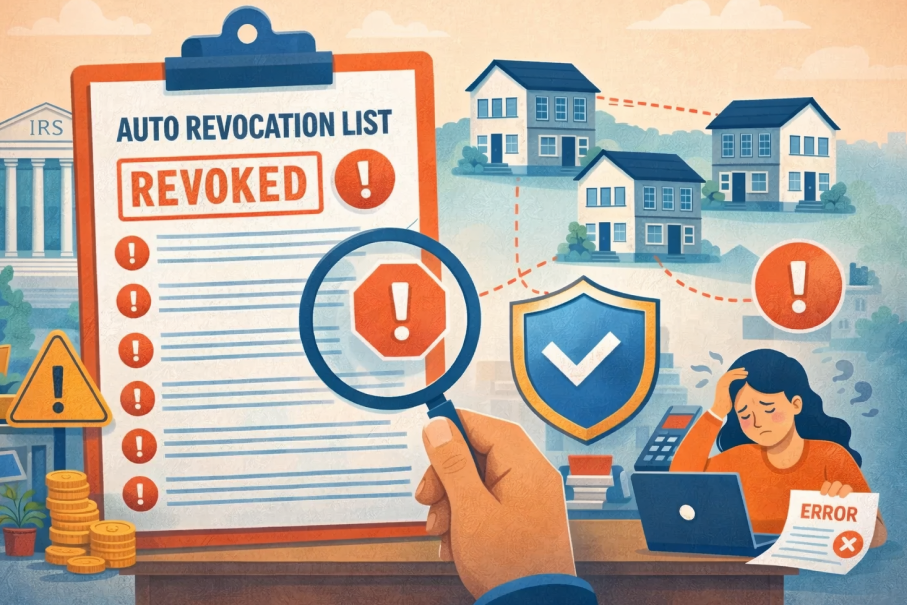
If you’re running a nonprofit, losing your tax-exempt status might seem like a distant worry, until it isn’t. Every year, thousands of nonprofits appear on the IRS Auto Revocation List after missing three consecutive years of required filings. The result is immediate: loss of tax-exempt status, donors who can’t deduct contributions, and a complex reinstatement process.
For single-entity nonprofits, this is serious. For multi-chapter and federated organizations, the risk is often quieter, and more dangerous.
Because sometimes, headquarters doesn’t even know it’s happened.
TL;DR
- The IRS Auto Revocation List is a public record of nonprofits that lost tax-exempt status after missing required filings for three consecutive years.
- Once listed, exemption is automatically revoked, there’s no appeal, only reinstatement.
- Consequences are immediate: donations stop being tax-deductible, grants and contracts may be lost, and federal (and sometimes state) taxes may apply.
- You can check status in minutes using the IRS Tax Exempt Organization Search by name or EIN.
- Small, volunteer-run nonprofits are most at risk due to leadership turnover and confusion about filing rules.
- For federated nonprofits, a single chapter can appear on the IRS Auto Revocation List without HQ receiving notice, creating oversight gaps across the network.
- Reinstatement is possible through four IRS pathways, some allow retroactive restoration within strict timelines.
- Prevention is simple but non-negotiable: file every year, track deadlines, and maintain centralized visibility.
A Critical Note for Multi-Chapter and Federated Organizations
For multi-chapter nonprofits, associations, and national organizations, the IRS Auto Revocation List presents an oversight risk.
In many federated structures, chapters file independently under their own EINs. A single chapter’s failure to file Form 990 for three consecutive years can trigger automatic revocation, without headquarters receiving any direct IRS notice.
National teams often discover the issue only after:
- A donor flags a deduction issue
- A bank runs an EIN verification
- A sponsor conducts due diligence
- A chapter attempts to open an account
- A grant application is rejected
By that point, the chapter is already listed, and reinstatement timelines may already be running.
For HQ leaders, this is a compliance matter and a visibility and governance issue.
What Is the IRS Auto Revocation List?
The IRS Auto Revocation List is a public record of organizations that have lost their tax-exempt status for failing to file required annual returns for three consecutive years.
The rule stems from the Pension Protection Act of 2006, which mandates automatic revocation after three years of non-filing.
Key details:
- The IRS updates the list monthly.
- Revocation is automatic and statutory.
- There is no appeal process for a valid revocation.
- Organizations must apply for reinstatement.
What Information Appears on the List?
For each revoked organization, the IRS displays:
- Organization name
- EIN (Employer Identification Number)
- Organization type (e.g., 501(C)(3))
- Last known address
- Effective date of revocation
- Date added to the list
- Reinstatement date (if applicable)
For HQ teams managing multiple EINs, this list effectively becomes a decentralized risk ledger.
Why Nonprofits and Chapters End Up on the List
Automatic revocation happens when a nonprofit, or an independently filing chapter within a larger organization, fails to file the required Form 990-series return for three consecutive years.
Filing Requirements by Size
- Under $50,000 in gross receipts → File Form 990-N
- $50,000–$199,999 in gross receipts and under $500,000 in assets → File Form 990-EZ or 990
- $200,000+ in gross receipts OR $500,000+ in assets → File Form 990
- Private foundations → File Form 990-PF
Filing deadline: The 15th day of the 5th month after fiscal year-end.
Example: December 31 year-end → May 15 deadline.
Common Reasons Filings Get Missed
Small nonprofits and local chapters are especially vulnerable because:
- Leadership turnover disrupts continuity
- Volunteer boards don’t realize filings are required
- Inactive status is mistaken for no filing obligation
- Religious exemptions are misunderstood
- Filing responsibility isn’t clearly assigned
Even if inactive, organizations must file unless formally dissolved. For federated organizations, risk multiplies when:
- HQ assumes chapters are filing
- Chapters assume HQ is monitoring
- There is no centralized EIN registry
- Filing confirmation isn’t required annually
That’s how exposure accumulates.
What Happens When You’re Auto-Revoked?
The consequences are immediate.
For the Organization or Chapter
- Loss of federal tax-exempt status
- Potential corporate income tax liability
- Removal from IRS Publication 78
- Possible impact on state exemptions
For Donors
- Contributions become non-deductible as of the revocation date
- Major donors may pause or withdraw support
For Grants and Contracts
- Government eligibility may be lost
- Foundations may suspend funding
- Contracts requiring tax-exempt status may terminate
There is no appeal process. The only option is reinstatement.
How to Check the IRS Auto Revocation List
Checking takes minutes.
Step 1: Visit IRS Tax Exempt Organization Search
Go to the IRS website and open the Tax Exempt Organization Search tool.
Step 2: Search by Name or EIN
Search using:
- Organization name
- EIN (most accurate method)
- City and state
For federated organizations: Run periodic checks on all chapter EINs, not just the national office.
Step 3: Review Results
Look for:
- Effective revocation date
- Date added to list
- Reinstatement status
How to Confirm Reinstatement
Organizations remain on the list even after reinstatement, it’s a historical record. To confirm reinstatement:
- Check for a reinstatement date on the list
- Verify inclusion in IRS Publication 78
- Review the updated IRS determination letter
What to Do If You’re on the IRS Auto Revocation List
Reinstatement is possible. The IRS provides four pathways.
1. Streamlined Retroactive Reinstatement (Most Common for Small Nonprofits)
Eligibility:
- Eligible to file 990-N or 990-EZ
- Not previously auto-revoked
- Apply within 15 months
Requirements:
- File Form 1023, 1023-EZ, 1024, or 1024-A
- Submit delinquent returns
- Pay user fee
Benefit: Retroactive restoration to revocation date.
2. Retroactive Reinstatement Within 15 Months (Larger Organizations)
Requires:
- Filing full application
- Reasonable cause statement
- All delinquent returns
3. Retroactive Reinstatement After 15 Months
If more than 15 months have passed since the revocation letter was issued or the organization appeared on the IRS Auto Revocation List, retroactive reinstatement is still possible, but the standard becomes significantly stricter.
At this stage, the organization must demonstrate reasonable cause for each of the three consecutive years of missed filings, not just one. The IRS expects a detailed explanation covering:
- Why each return was not filed
- How and when the failure was discovered
- What corrective actions have been implemented
- What systems are now in place to prevent recurrence
For multi-chapter organizations, this often requires reconstructing leadership transitions, communication gaps, or oversight breakdowns at the chapter level. The longer the delay, the higher the burden of documentation and explanation.
Retroactive relief is possible, but it requires a compelling, well-supported case.
4. Prospective Reinstatement
Easiest option:
- File new exemption application
- Status restored from application date
Downside: No retroactive protection.
Application Fees (2026)
As of 2026, the IRS user fees for exemption and reinstatement applications are:
- Form 1023-EZ: $275
- Form 1023 (standard application): $600
- Form 1024-A (primarily for 501(C)(4) organizations): $275
These fees are paid electronically through Pay.gov at the time of submission. Because user fees are set through IRS revenue procedures and can change periodically, organizations should confirm the current amount on IRS.gov before filing.
How to Prevent Auto Revocation
Auto revocation is rarely about intent. It is almost always about process.
For single-entity nonprofits, prevention is about consistency. For multi-chapter or federated organizations, prevention is about visibility and structural oversight.
Here’s how to reduce the risk.
1. Know Your Filing Deadline and Institutionalize It
Form 990-series returns are due on the 15th day of the 5th month after your fiscal year ends. Examples:
- December 31 year-end → May 15 deadline
- June 30 year-end → November 15 deadline
Do not rely on individual memory. Institutionalize the date:
- Add it to organizational compliance calendars
- Include it in board onboarding materials
- Maintain it in your governance handbook
- Set multi-person calendar reminders
Deadlines should live in systems.
2. File Extensions Proactively When Needed
If you cannot meet the original deadline, file Form 8868 before the due date for an automatic six-month extension. Important notes:
- The extension must be filed before the original due date.
- Form 990-N (e-Postcard) cannot be extended, but filing late is better than skipping.
- Missing three consecutive filings triggers automatic revocation.
Extensions are compliance tools.
3. Assign Clear Responsibility and Document It
One of the most common causes of revocation is ambiguous ownership. Prevention requires clear accountability:
- Identify who is responsible for preparing and submitting Form 990
- Document this responsibility in governance policies
- Include it in the treasurer or finance officer job description
- Require formal confirmation of submission each year
For federated organizations, define whether filing responsibility sits with:
- Local chapters
- Regional leadership
- National headquarters
- Or a shared compliance function
Ambiguity creates risk. Clarity reduces it.
4. Maintain Organized, Year-Round Financial Records
Compliance stress increases when financial data is scattered. Maintain organized records of:
- Gross receipts
- Program expenses
- Administrative costs
- Compensation and contractor payments
- Restricted funds
- In-kind contributions
When records are maintained throughout the year, filing becomes procedural rather than reactive. For HQ leaders, this also supports consistency across chapters.
5. Monitor Chapter-Level Filing Status (For Federated Organizations)
If chapters operate under separate EINs, the risk profile changes. Headquarters may not receive direct IRS notices for chapter non-filing. That means prevention must include structural visibility. Recommended controls:
- Maintain a centralized EIN registry of all chapters
- Track each chapter’s Form 990 filing type and due date
- Require annual filing confirmation from chapter leadership
- Periodically run EIN checks using the IRS Tax Exempt Organization Search
- Include filing compliance status in quarterly or annual board reporting
Even if chapters file independently, oversight should not be informal. Decentralized authority requires centralized visibility.
6. Build Compliance Continuity Into Leadership Transitions
Leadership turnover is one of the most common triggers for missed filings. Mitigate this by:
- Including IRS filing requirements in transition checklists
- Preserving login credentials for filing systems in secure, centralized storage
- Maintaining documented compliance procedures
- Avoiding reliance on personal email accounts for IRS correspondence
When compliance knowledge lives with individuals instead of systems, risk increases.
7. Consider Professional or Automated Support
Many nonprofits reduce exposure by:
- Engaging a CPA familiar with Form 990
- Using nonprofit-specific accounting software
- Implementing compliance tracking systems
- Centralizing oversight across entities
For multi-entity organizations, technology can help create structured oversight where manual coordination often fails.
Auto revocation is the predictable result of three missed filings. With defined ownership, documented processes, and structured visibility, especially across chapters, organizations can keep compliance steady and avoid appearing on the IRS Auto Revocation List. Prevention is disciplined.
How Crowded Helps Multi-Chapter Organizations Stay Compliant
Managing Form 990 compliance across chapters is about visibility, coordination, and accurate IRS reporting across a network of EINs. Crowded provides a suite of nonprofit-focused financial and compliance tools that help organizations:
- Prepare and e-file Form 990 annually using AI-assisted tools that streamline form completion and reduce manual burden.
- Track tax-exempt status and compliance across chapters with a centralized Chapter Tracker dashboard that gives headquarters visibility into each subsidiary’s filing status and risks.
For multi chapter organizations, this means compliance isn’t left to scattered spreadsheets or informal check-ins, it’s surfaced and organized in one place so HQ teams can address issues proactively rather than reactively.
Final Thoughts
The IRS Auto Revocation List is designed to enforce basic filing requirements. For single-entity nonprofits, the risk is straightforward. For federated organizations, the risk is structural.
A single chapter can miss three filings quietly. HQ may only discover it when a donor, bank, or grantmaker does. The good news:
- Checking status takes minutes
- Reinstatement pathways exist
- Prevention is entirely achievable with the right systems
Three missed filings should not derail your mission or your network. If you operate a multi-chapter organization, now is the time to review chapter EIN visibility, confirm filing compliance, and build systems that prevent surprises. Because in federated structures, revocation rarely starts at headquarters.
It starts quietly. And it starts locally.
Your questions, answered.
What If I Received a Revocation Letter But Think It's a Mistake?
Contact the IRS Tax Exempt and Government Entities Customer Service at (877) 829-5500. Common mistakes include:
- You were filing under a group exemption and shouldn’t have been listed
- You submitted your returns but the IRS didn’t record them
- Your organization is actually exempt from filing (some religious organizations)
If you were listed in error and can provide proof, the IRS will remove you from the list.
Do Religious Organizations Need to File?
Most churches and church-affiliated organizations are exempt from filing Form 990. However, church-affiliated nonprofits that operate separately (like schools or hospitals) may need to file. When in doubt, check with the IRS or a tax professional.
What If We're a Subordinate in a Group Exemption?
If you’re part of a group ruling and the parent organization files a group return on your behalf, you don’t need to file separately. However, if you were auto-revoked, you’ll need to apply for reinstatement individually and cannot simply rejoin the group exemption.
Can We Operate While Waiting for Reinstatement?
Yes, but you’re operating as a taxable entity during this period. You’ll owe income taxes on net income, and donations won’t be tax-deductible until your status is reinstated.
What If We Want to Close Our Nonprofit Instead?
If your organization is no longer active and you don’t plan to continue, you should formally dissolve. File a final Form 990 checking the “terminating” box and follow your state’s dissolution procedures. This prevents future compliance issues.
How Can We Reduce the Risk of Auto Revocation Across Chapters?
Auto revocation usually happens when filings go unmonitored. HQ teams should maintain a centralized list of chapter EINs and confirm annual Form 990 submissions across entities. Tools like Crowded offer multi-chapter dashboards and group exemption management, which help centralize filing visibility and reduce the chance that missed filings go unnoticed.
Does Crowded Help With Filing and Compliance?
Yes. Crowded provides AI-powered Form 990 preparation and IRS-certified e-filing for 990-N, EZ, and full Form 990s. It also includes compliance management features and centralized chapter tracking, which can help HQ teams stay on top of annual filing requirements.
Can Crowded Help Prevent Auto Revocation?
While no tool can guarantee prevention, structured visibility and regular filing are key. By centralizing financial and compliance data, offering annual 990 e-filing, and giving HQ teams visibility into chapter status through a Chapter Tracker, Crowded helps organizations build routines and oversight that reduce the risk of missed filings and potential auto revocation.