


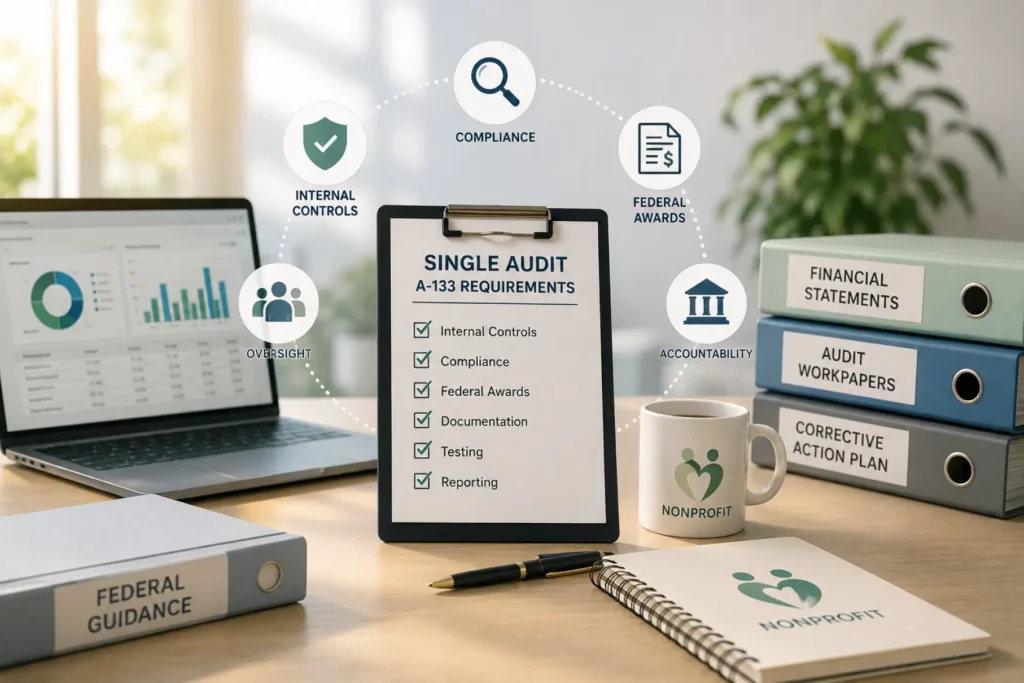
A nonprofit Single Audit A-133 can quickly turn federal funding growth into a compliance test. This guide explains who must comply, how the requirements work, what auditors request, and how nonprofit CFOs and controllers can prepare before year-end pressure builds.
TL;DR
- A Single Audit A-133 is triggered when your organization expends $750,000+ in federal awards.
- The biggest audit risks usually stem from weak documentation, unclear grant tracking, poor approval records, and gaps in subrecipient monitoring.
- Your SEFA is the backbone of the audit, so federal expenditures need to be tracked by award, program, period, and funding source before year-end.
- Nonprofits with chapters, multiple grants, or distributed teams need stronger financial visibility because scattered records can quickly slow down audits.
- Crowded* helps finance teams manage grant activity, approvals, documentation, and chapter oversight more easily before audit season starts.
What Is a Nonprofit Single Audit A-133 Requirement?
A Single Audit A-133 applies when an organization expends $750,000 or more in federal awards during its fiscal year. While A-133 is historical, today’s requirements are governed by Uniform Guidance under 2 CFR Part 200, Subpart F.
A nonprofit Single Audit A-133 engagement typically reviews how the organization:
- Used federal funds appropriately
- Maintained compliant internal controls
- Tracked federal expenditures correctly
- Followed grant terms and procurement rules
- Prepared an accurate SEFA
- Monitored subrecipients properly
- Filed audit documentation with the Federal Audit Clearinghouse on time
Unlike a standard financial statement audit, a nonprofit Single Audit A-133 review specifically focuses on federal compliance risk.
Who Is Required to Get a Single Audit?
A nonprofit generally needs a Single Audit (A-133) when it expends $750,000 or more in federal awards during a fiscal year. The important distinction is that the requirement is based on federal expenditures.
Cash Received vs. Federal Expenditures
Many nonprofit finance teams misunderstand the difference between receiving federal funds and expending federal awards. Receiving funds means the organization obtained federal money through advance payments, reimbursements, or pass-through funding. Expending funds means the nonprofit actually used those federal awards in accordance with applicable accounting and compliance rules.
For example:
- A nonprofit may receive a $1 million federal grant but only expend $500,000 during the fiscal year.
- Another organization may receive reimbursement after already expending $800,000 in allowable program costs.
- Deferred spending can shift nonprofit Single Audit A-133 requirements into a later fiscal year.
This distinction is critical for accurate SEFA reporting and determining if your nonprofit meets the federal audit threshold.
Trigger checklist:
- Did your nonprofit expend $750,000 or more in federal awards?
- Did the funding come directly from a federal agency?
- Did the funding pass through a state, city, county, university, or intermediary organization?
- Can your finance team isolate federal expenditures by award?
- Did your organization pass federal funds to subrecipients?
- Can you support all federal expenditures with documentation?
If the answer to the threshold requirement is yes, your organization likely needs a nonprofit Single Audit under A-133.
How Pass-Through Entities Affect Audit Requirements
Many Single Audit A-133 obligations for nonprofits involve pass-through entities rather than direct federal funding relationships.
A nonprofit may receive federal awards through:
- State agencies
- Local governments
- Universities
- Fiscal sponsors
- Larger nonprofits
- Community development intermediaries
Even when funding does not come directly from a federal department, federal compliance obligations may still apply.
Pass-through documentation should identify:
- Federal agency information
- Assistance Listing number
- Award name
- Pass-through entity name
- Amount passed through
- Applicable compliance requirements
Without clear documentation, preparing the nonprofit Single Audit under A-133 becomes significantly more difficult.
Why Subrecipient Monitoring Creates Audit Risk
Subrecipient monitoring is one of the most common risk areas in a nonprofit Single Audit A-133 engagement. When a nonprofit passes federal awards to another organization, auditors often review the controls, oversight processes, and documentation used to monitor those funds.
Auditors may request evidence showing the nonprofit:
- Assessed subrecipient risk
- Used written agreements
- Reviewed invoices and reports
- Verified allowable costs
- Followed up on findings
- Maintained monitoring records
Strong subrecipient documentation often determines whether a nonprofit’s Single Audit A-133 review proceeds smoothly or becomes delayed by compliance questions.
What Documentation Is Needed for the SEFA?
The Schedule of Expenditures of Federal Awards, or SEFA, is one of the central documents in a nonprofit Single Audit A-133 review. The SEFA summarizes federal expenditures during the fiscal year and helps auditors determine which federal programs require testing.
A typical SEFA includes:
- Federal agency names
- Assistance Listing numbers
- Program names
- Award numbers
- Pass-through entity information
- Federal expenditures by program
- Amounts passed to subrecipients
- Notes explaining presentation methods
A weak SEFA creates audit risk because auditors rely on it to identify major programs and compliance testing requirements.
What Auditors Usually Request
Auditors conducting a nonprofit Single Audit A-133 review usually request documentation across several operational areas.
Grant documentation
- Grant agreements
- Award notices
- Contract amendments
- Federal program details
- Approved budgets
Financial records
- General ledger exports
- Payroll allocations
- Bank statements
- Expense reports
- Reimbursement records
- Drawdown schedules
Internal controls
- Approval workflows
- Procurement procedures
- Spending policies
- Segregation of duties documentation
- Board approvals
Compliance evidence
- Program reports
- Eligibility records
- Procurement files
- Vendor agreements
- Time and effort documentation
- Subrecipient monitoring files
SEFA support
- Federal expenditure schedules
- Reconciliations to the general ledger
- Deferred spending documentation
- Advance funding records
- Pass-through tracking records
What Happens if a Nonprofit Fails to File the Audit on Time?
Nonprofit Single Audit A-133 reporting packages are submitted through the Federal Audit Clearinghouse. The filing deadline is generally 30 days after receiving the auditor’s report or 9 months after the fiscal year-end, whichever comes first.
Late filing can create several consequences:
- Delayed federal funding
- Increased grantor scrutiny
- Corrective action requirements
- Additional oversight
- Reputation concerns with funders
- Future grant eligibility issues
Operationally, late nonprofit Single Audit A-133 filings often signal deeper process problems involving grant tracking, documentation management, or internal controls.
How to Prepare for a Single Audit (Without Scrambling at Year-End)
The best nonprofit Single Audit A-133 preparation begins months before the audit.
- Identify all federal funding sources early. Track direct federal awards and pass-through funding relationships from the beginning of the fiscal year.
- Separate expenditures by award. Your accounting structure should isolate federal expenditures by grant, funding source, and fiscal period.
- Distinguish received funds from expended funds. Advance funding, reimbursements, deferred revenue, and restricted balances should all be documented clearly.
- Build SEFA support throughout the year. Do not wait until audit season to assemble federal expenditure schedules.
- Maintain approval documentation continuously. Auditors expect approval evidence tied directly to transactions and expenditures.
- Monitor subrecipients consistently. Keep agreements, reports, and monitoring documentation organized throughout the year.
- Schedule audit readiness reviews before year-end. Early communication with auditors often prevents last-minute compliance surprises.
Where Many Nonprofits Struggle Operationally
Many nonprofits struggle with Single Audit A-133 preparation because their operational systems were built for bookkeeping rather than federal compliance visibility.
Common operational gaps include:
- Federal records scattered across spreadsheets and inboxes
- Weak approval documentation
- Separate chapter bank accounts
- Manual grant reconciliations
- Inconsistent reimbursement tracking
- Limited visibility into restricted funds
- Poor subrecipient oversight documentation
Crowded helps nonprofits centralize financial visibility, organize grant-level accounts, document approvals, and oversee activity across chapters and programs. For teams managing federal funds across multiple grants or locations, that structure can make nonprofit Single Audit A-133 preparation easier before year-end. Crowded helps keep the records auditors need easier to find, review, and export.
Single Audit Preparation Checklist
Use this nonprofit Single Audit A-133 checklist before year-end:
- Confirm whether federal expenditures exceeded $750,000
- Identify all direct and pass-through federal awards
- Collect Assistance Listing numbers
- Separate federal and non-federal revenue
- Reconcile federal expenditures monthly
- Prepare SEFA support documentation
- Document advance funding and deferred spending
- Maintain approval workflows and procurement records
- Review subrecipient agreements
- Organize compliance evidence
- Prepare internal control documentation
- Schedule auditor readiness meetings
- Prepare Federal Audit Clearinghouse submission requirements
- Track filing deadlines carefully
Preparing for a nonprofit Single Audit A-133 review becomes much easier when federal expenditures, approvals, grant documentation, and compliance evidence are organized throughout the year rather than reconstructed at the last minute.
If your nonprofit is approaching the federal audit threshold, now is the right time to strengthen the operational systems supporting grant compliance, reporting visibility, and audit readiness.
* Crowded Technologies Inc is a financial technology company and is not a bank. Banking services provided by i3 Bank; Member FDIC. The Crowded Technologies Inc. Visa® Debit Card is issued by i3 Bank pursuant to a license from Visa U.S.A. Inc. and may be used everywhere Visa debit cards are accepted.
There are no fees associated with account opening, but transaction fees may apply; please refer to the Crowded Business Deposit Account Agreement for more details on account transaction fees.
Frequently Asked Questions
Does a Single Audit increase the likelihood of future federal funding?
Yes. A clean Single Audit can demonstrate to funders that your nonprofit manages federal funds responsibly and maintains strong financial controls.
How long should nonprofits keep Single Audit documentation?
Most nonprofits should retain federal award records for at least 3 years after the final expenditure report, unless the grant requires a longer retention period.
Can multiple federal grants be combined when tracking expenditures?
They may appear together on the SEFA, but each federal award should be tracked separately throughout the year.
What are common findings in a nonprofit Single Audit?
Common findings include missing documentation, weak controls, procurement issues, reporting errors, late filings, and poor subrecipient monitoring.
How can chapters or affiliates prepare for a Single Audit?
They should use consistent documentation, approval, and oversight processes across the network to reduce audit risk.
Can banking structure affect audit readiness?
Yes. Centralized financial visibility makes it easier to find records, reconcile transactions, and support audit requests.
What if a nonprofit expects to cross the $750,000 threshold next year?
Start preparing now by strengthening grant tracking, documentation, internal controls, and approval workflows before the audit is required.
How does Crowded help nonprofits prepare for future audits?
Crowded helps nonprofits create clearer financial visibility across grants, chapters, and programs. Features such as grant-level account structures, approval workflows, centralized documentation, and chapter oversight can help finance teams maintain cleaner records throughout the year instead of reconstructing information during audit season.
Does Crowded replace accounting software or auditors?
No. Crowded is not a replacement for your accounting system or audit firm. Instead, it provides operational infrastructure that helps nonprofits organize financial activities, approvals, and documentation to support stronger compliance and audit readiness.