


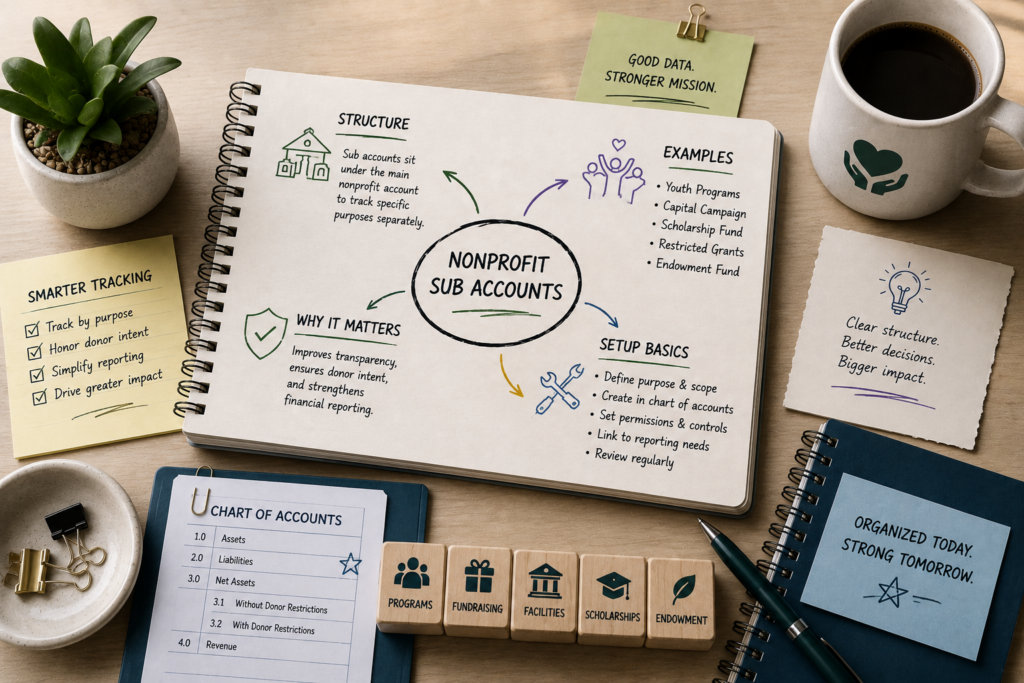
Nonprofit sub accounts help organizations separate, track, and manage money by program, grant, chapter, campaign, department, or restricted fund without losing sight of the full financial picture. For many nonprofits, the problem is that money is mixed.
A grant lives in one spreadsheet. A chapter keeps its own balance. A program director tracks expenses in an email. Finance sees the full bank account balance, but not always the purpose behind every dollar. That creates risk during audits, Form 990 preparation, board reporting, grant reporting, and leadership transitions.
Sub accounts solve that by providing structure to nonprofit finances. When built well, they help nonprofit teams answer three questions quickly:
- Whose money is this?
- What is it allowed to be used for?
- Who can access, spend, or report on it?
TL;DR
- Nonprofit sub accounts help finance teams separate grants, programs, chapters, campaigns, and restricted funds without losing centralized visibility.
- They reduce spreadsheet dependency by making it easier to track fund purpose, spending rules, and reporting responsibilities.
- For CFOs, controllers, and nonprofit boards, sub accounts improve audit readiness, Form 990 preparation, grant reporting, and financial oversight.
- Sub accounts are often cleaner than opening multiple bank accounts* because they support separation without adding banking complexity.
- Crowded brings sub accounts into daily operations with permissions, budgets, chapter-level autonomy, and centralized controls built for modern nonprofit finance.
What Are Nonprofit Sub Accounts?
Nonprofit sub accounts are smaller financial tracking categories under a main account, fund, program, grant, chapter, or department. They help nonprofits organize funds by purpose while keeping reporting aligned with the broader financial system.
In simple terms, nonprofit sub accounts create cleaner visibility. Instead of treating all cash, revenue, and expenses as a single pool, a nonprofit can separate activities for restricted funds, local chapters, events, scholarships, campaigns, or fiscal sponsorship projects.
For example, a nonprofit may have one main operating account, with sub accounts for:
- General operations
- Youth program
- Annual gala
- Restricted grant
- Local chapter
- Emergency assistance fund
The goal is to make financial reality easier to see.
What Is the Purpose of Sub Accounts in Nonprofits?
The purpose of sub accounts is to connect money to responsibility. Nonprofits rarely manage one simple stream of income. They manage donations, grants, dues, sponsorships, reimbursements, event revenue, restricted gifts, program expenses, and administrative costs. Each may carry different rules.
Sub accounts help nonprofits:
- Track restricted funds in nonprofit accounting more clearly
- Separate program budgets from operating funds
- Monitor grant spending against approved use
- Give chapters or committees controlled financial independence
- Prepare cleaner reports for boards, funders, and auditors
- Support Form 990 reporting with better categorization
- Reduce manual spreadsheet reconciliation
A sub account is especially useful when the nonprofit needs separation without opening a completely separate bank account.
Examples of Nonprofit Sub Accounts
Common examples of nonprofit sub accounts include:
Program sub accounts:
- Youth Mentorship Program
- Food Pantry Program
- Community Legal Aid Program
Grant sub accounts:
- State Capacity Grant
- Foundation Literacy Grant
- Federal Reimbursement Grant
Chapter sub accounts:
- New York Chapter
- Austin Chapter
- Manila Chapter
Campaign sub accounts:
- Year-End Giving Campaign
- Capital Campaign
- Disaster Relief Campaign
Department sub accounts:
- Development
- Programs
- Operations
- Finance
Restricted fund sub accounts:
- Scholarship Fund
- Building Fund
- Donor-Restricted Medical Fund
A practical nonprofit general ledger example might show event ticket revenue, sponsorship income, venue expenses, and catering costs all assigned to the “Annual Gala” sub account. That way, the finance team can report whether the event actually generated net revenue.
How Sub Accounts Fit Into a Nonprofit Chart of Accounts
A nonprofit chart of accounts is the master structure used to classify assets, liabilities, net assets, revenue, and expenses. Sub accounts sit underneath that structure to add detail.
A light nonprofit chart of accounts template might look like this:
Assets
1000 Cash
1010 Main Operating Account
1011 Youth Program Sub Account
1012 Scholarship Fund Sub Account
1013 Chapter Funds Sub Account
Revenue
4000 Contributions
4010 Unrestricted Donations
4020 Restricted Donations
4030 Grant Revenue
4040 Membership Dues
4050 Event Revenue
Expenses
5000 Program Expenses
5010 Youth Program Expenses
5020 Scholarship Disbursements
5030 Chapter Expenses
6000 Administrative Expenses
6010 Software
6020 Professional Fees
6030 Insurance
7000 Fundraising Expenses
7010 Event Costs
7020 Donor Communications
7030 Sponsorship Materials
The chart of accounts defines the structure of the accounting system. Sub accounts give that structure usefulness.
How to Set Up Nonprofit Sub Accounts (QuickBooks + General)
Setting up nonprofit sub accounts depends on your system, but the logic is similar across most accounting platforms.
General setup steps:
- Define what needs separation. Start with the reason for the sub account. Is it a grant, program, fund, chapter, campaign, or department?
- Match the sub account to reporting needs. Create them when someone needs to report on them, restrict them, budget them, or reconcile them.
- Name accounts clearly. Use names that make sense to finance and non-finance users. “2026 Youth Literacy Grant” is better than “Grant 4.”
- Align sub accounts with budgets. Each sub account should connect to an approved budget, funding source, or responsibility owner.
- Document the rules. Note who can spend from it, what expenses are allowed, what documentation is required, and how often it should be reviewed.
- Reconcile regularly. A sub account only works if transactions are categorized consistently.
For QuickBooks nonprofit sub accounts, organizations often create parent accounts and subaccounts under banking, income, or expense categories. This can help with internal tracking, but it still depends heavily on consistent coding, user discipline, and review.
Common mistakes include:
- Creating too many sub accounts
- Mixing restricted and unrestricted activity
- Using vague names
- Forgetting to close inactive sub accounts
- Tracking sub accounts in spreadsheets, but not in the ledger
- Giving local leaders spending access without visibility or controls
Sub Accounts vs Separate Bank Accounts for Nonprofits
The question of separate bank accounts vs sub accounts that nonprofit teams face usually comes down to control, visibility, and administrative burden. Separate bank accounts can be useful when funds require legal, operational, or banking separation. They may make sense for separately incorporated entities, certain fiscal sponsorship models, or specific funder requirements.
Pros of separate bank accounts:
- Stronger physical separation of funds
- Clearer banking boundaries
- Useful for legally distinct entities
Cons of separate bank accounts:
- More bank paperwork
- More reconciliation work
- Harder leadership transitions
- Fragmented visibility
- Greater risk of inconsistent controls
Sub accounts are often better when the nonprofit needs internal separation without creating unnecessary banking complexity.
Pros of sub accounts:
- Easier consolidated reporting
- Better central oversight
- Cleaner budget tracking
- Faster setup
- Less administrative burden
- Stronger visibility across programs or chapters
Cons of sub accounts:
- Require clear internal rules
- Depend on proper categorization
- May not satisfy every legal or grant requirement
Separate bank accounts create separation at the banking level. Sub accounts create separation at the management and reporting level.
How Modern Platforms Handle Sub Accounts Differently
Traditional sub accounts often live inside accounting software or spreadsheets. That helps with reporting, but it does not always help with day-to-day control. Modern platforms like Crowded handle sub accounts as operational tools. Crowded helps nonprofits manage sub accounts with operational controls, permissions, budgets, visibility, and centralized oversight.
That matters because many nonprofit finance problems happen before the accounting report is created. A spreadsheet can show that a chapter overspent. A modern sub-account system can help prevent overspending.
Crowded supports nonprofit teams by connecting sub accounts with:
- Operational permissions
- Admin access by account
- Budget visibility
- Chapter-level autonomy
- HQ-level oversight
- Transaction visibility
- Faster leadership transitions
- Centralized reporting
That is the difference between tracking money after the fact and managing money while decisions are being made.
Best Practices for Structuring Sub Accounts in Nonprofits
A strong sub-account structure should be simple enough to maintain and detailed enough to support decisions.
Best practices include:
- Build around reporting needs
- Separate restricted funds from unrestricted funds
- Use consistent naming conventions
- Avoid duplicate sub accounts for the same activity
- Assign one owner per sub account
- Review inactive accounts quarterly
- Tie every sub account to a budget or purpose
- Document spending rules
- Reconcile sub accounts before board meetings
- Keep finance, program, and development teams aligned
For grant-funded nonprofits, sub accounts should make it easy to show how money was received, spent, and documented. For chapter-based nonprofits, sub accounts should show local balances without cutting headquarters out of oversight. For fiscal sponsors, sub accounts should help distinguish project activity while preserving consolidated reporting.
Conclusion
Nonprofit sub accounts are a governance tool. They help nonprofit leaders protect restricted funds, reduce reporting confusion, support cleaner audits, prepare stronger Form 990 documentation, and give boards a clearer view of how money moves through the organization.
The old way was to open more bank accounts, build more spreadsheets, and hope that everyone would categorize transactions correctly later. The better way is to create a structure where funds are separated by purpose, permissions align with responsibilities, and leadership can see the full picture without taking control away from the people doing the work.
Crowded helps nonprofits bring that structure into daily financial operations with sub accounts, permissions, budgets, visibility, and centralized oversight built for how nonprofits actually work.
* Crowded Technologies Inc is a financial technology company and is not a bank. Banking services provided by i3 Bank; Members FDIC. The Crowded Technologies Inc. Visa® Debit Card is issued by i3 Bank pursuant to a license from Visa U.S.A. Inc. and may be used everywhere Visa debit cards are accepted.
Frequently Asked Questions
Can nonprofit sub accounts help during leadership turnover?
Yes. Sub accounts preserve transaction history, budgets, and permissions even when leadership changes. Crowded helps maintain continuity with centralized visibility and oversight.
Do nonprofit sub accounts reduce audit preparation time?
They can reduce audit prep by keeping expenses, grants, and restricted funds categorized from the start. Finance teams spend less time rebuilding records, and auditors get cleaner documentation trails.
Should every nonprofit program have its own sub account?
Not always. A sub account should exist only if the nonprofit needs separate reporting, budgeting, oversight, or spending controls for that activity. Creating too many sub accounts can make reporting harder instead of easier. The best structures balance visibility with simplicity.
How do sub accounts help multi-chapter nonprofits?
Sub accounts let chapters operate independently while HQ maintains visibility into balances, expenses, and activity. Crowded supports this balance with chapter-level autonomy and centralized oversight.
Can sub accounts improve board reporting?
Yes. Sub accounts help boards see program performance, restricted funds, chapter activity, and financial risk more clearly.