


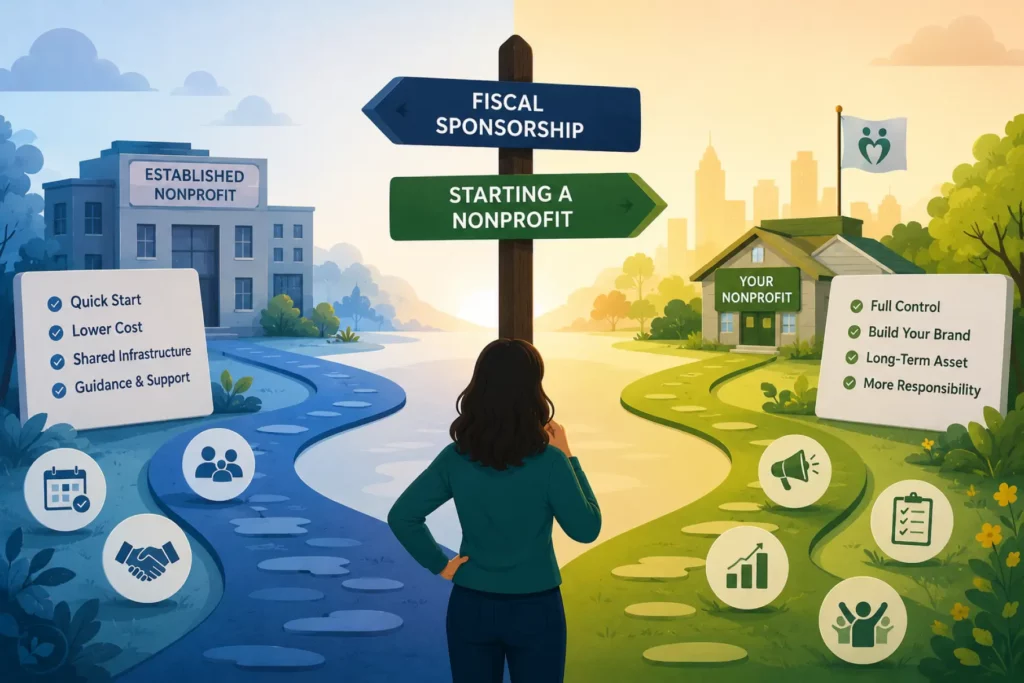
Choosing between fiscal sponsorship and nonprofit formation is a decision about speed, control, compliance capacity, donor deductibility, and long-term operating structure. For consultants, fiscal sponsor operators, association executives, and nonprofit advisors, the right answer depends less on ambition and more on whether the project is ready to carry its own governance, banking, grant management, reporting, and audit-readiness obligations.
TL;DR
- Fiscal sponsorship is usually the faster path for projects that need to accept tax-deductible donations, secure grants, and launch programs quickly without building a standalone nonprofit from day one.
- Starting a nonprofit makes more sense for permanent organizations with dedicated staff, independent governance, long-term fundraising strategies, and the capacity to manage compliance, reporting, and financial oversight internally.
- The right decision depends on four factors: the timeline, the funding model, the control requirements, and the administrative readiness.
- Not all fiscal sponsorship models are the same. Understanding the difference between comprehensive fiscal sponsorship and pre-approved grant relationship sponsorship can significantly affect governance, grant management, and operational flexibility.
- The strongest structures pair legal strategy with financial infrastructure. Whether operating under a sponsor or independently, organizations need clear fund tracking, reporting, permissions, and audit-ready financial visibility to scale confidently.
What Is the Difference Between Fiscal Sponsorship vs Nonprofit Formation?
Fiscal sponsorship lets a charitable project operate under an existing nonprofit’s tax-exempt status, while starting a nonprofit creates a new legal entity with its own board, EIN, bank accounts, compliance duties, and IRS recognition process.
Decision Factor | Fiscal Sponsorship | Starting a Nonprofit |
Launch speed | Faster, often weeks | Slower; often months |
Tax status | Uses sponsor’s 501(c)(3) status | Must apply for own exemption |
Governance | Sponsor has formal oversight | An independent board governs |
Compliance burden | Shared or managed by the sponsor | Fully owned by a new nonprofit |
Control | Lower, depending on the model | Higher operational control |
Setup cost | Usually lower upfront | Higher legal, filing, and admin costs |
Fiscal sponsorship is often the better fit when a project needs to receive deductible donations or grants quickly but does not yet need full institutional independence. Nonprofit formation is usually better when the work is permanent, staffed, independently governed, and expected to build its own donor base, contracts, programs, and compliance infrastructure.
The Four Variables Framework
The decision should be based on four operating variables: timeline, funding model, control needs, and administrative readiness. A project with urgent funding needs, uncertain duration, or limited back-office capacity often benefits from fiscal sponsorship. A project with a long-term mandate, dedicated leadership, independent governance needs, and sustained revenue may be ready to form a nonprofit.
Scenario 1: Disaster Relief Launching Next Month
Fiscal sponsorship is usually the better fit.
A disaster relief initiative that needs to collect donations next month cannot wait for full nonprofit setup, IRS recognition, banking workflows, grant controls, and board infrastructure. A qualified fiscal sponsor can help the project receive tax-deductible donations, manage restricted funds, process payments, and document activity quickly.
The key risk is operational chaos. Fast-moving relief work needs clear fund tracking, transparent approvals, and audit-ready documentation from day one.
Scenario 2: A 3-Year $50K Pilot
Fiscal sponsorship is often the better fit, at least initially.
A three-year pilot with $50,000 in expected funding may not justify the cost and administrative weight of forming a standalone nonprofit. Fiscal sponsorship can give the project a compliant home while it tests community need, funder interest, and operational viability.
The advisor’s role is to define exit criteria. If the pilot grows into recurring grants, paid staff, formal programs, and long-term funder commitments, nonprofit formation may become appropriate later.
Scenario 3: Experimental Arts Initiative
Fiscal sponsorship is usually the better fit.
Experimental arts projects often need donor deductibility, small grants, event revenue, and payment support without becoming permanent institutions. Fiscal sponsorship can give artists and cultural organizers access to charitable funding infrastructure while preserving flexibility.
The best sponsor relationship will provide transparent project balances, clean expense approvals, clear reporting, and visibility into restricted donations tied to exhibitions, performances, residencies, or community programming.
Scenario 4: Permanent Organization With Five Staff
Starting a nonprofit is the best fit.
A permanent organization with five staff members likely needs independent governance, direct grant relationships, employer systems, board accountability, insurance, banking control, and long-term compliance ownership. Fiscal sponsorship may still be useful during launch, but it can become restrictive once the organization needs institutional authority.
At this stage, the question shifts from “How fast can we launch?” to “Are we ready to govern, report, manage funds, and sustain compliance independently?”
Comprehensive Fiscal Sponsorship vs Pre-Approved Grant Relationship Sponsorship
Comprehensive fiscal sponsorship is best when the sponsor houses the project more fully. The project may operate as a program of the sponsor, with the sponsor managing charitable funds, financial controls, compliance, reporting, contracts, and oversight. This model fits projects that need more operational support, especially new initiatives without strong finance systems, board infrastructure, or compliance capacity.
Pre-approved grant relationship sponsorship is different. In this model, the sponsored project is often a separate entity or group that receives grants from the sponsor for approved charitable purposes. The sponsor does not fully absorb the project but still requires oversight, grant agreements, documentation, and reporting.
This model fits projects that already have some operational independence but need access to charitable funding, donor deductibility, or grant administration under a sponsor’s exempt purpose.
What to Look for in a Fiscal Sponsor
A fiscal sponsor should be evaluated as infrastructure. Strong sponsors have clear controls, transparent fees, documented approval workflows, restricted fund tracking, audit-ready records, and reporting that project leaders can understand. They should support multi-project oversight without forcing every project into disconnected spreadsheets, inbox approvals, and unclear bank activity.
Look for:
What to Evaluate | Why It Matters |
Financial controls | Reduces unauthorized spending and approval confusion |
Transparency | Helps projects understand balances, fees, and fund movement |
Restricted fund tracking | Protects donor intent and grant compliance |
Audit readiness | Makes records usable for reviews, funders, and year-end reporting |
Reporting | Gives project leaders and sponsors shared visibility |
Multi-project oversight | Helps sponsors manage several initiatives without losing control |
Crowded can fit here as an operational finance layer for sponsors, associations, and nonprofit networks managing multiple funds, chapters, projects, or programs. Crowded supports the financial infrastructure around the relationship: permissions, payments, collections, spend controls, restricted balances, documentation, and visibility across related activity.
Practical Decision Matrix
Use this matrix when advising projects on fiscal sponsorship vs nonprofit formation.
Project Situation | Better Fit | Why |
Needs to raise deductible donations quickly | Fiscal sponsorship | Faster path to compliant fundraising |
Testing a short-term pilot | Fiscal sponsorship | Avoids unnecessary entity burden |
Has no board or finance function | Fiscal sponsorship | The sponsor can provide oversight and controls |
Needs full governance independence | Nonprofit | Requires its own board and authority |
Has permanent staff and programs | Nonprofit | Needs a long-term institutional structure |
Manages complex grants independently | Nonprofit | May require direct compliance ownership |
Depends | Fiscal sponsor or nonprofit model needs strong fund controls | |
Unsure whether the project will last | Fiscal sponsorship | Preserves flexibility before formalizing |
Conclusion
The decision between fiscal sponsorship and nonprofit status is about aligning the project’s next 12–36 months with the appropriate levels of governance, donor deductibility, compliance, grant management, audit readiness, and financial controls.
Fiscal sponsorship can help urgent, experimental, or early-stage initiatives move faster without carrying the full weight of nonprofit formation too soon. Starting a nonprofit makes more sense when the project has permanence, staff, independent governance needs, and the operational maturity to manage its own compliance environment.
For sponsors and advisors, the strongest decisions pair the right legal structure with the right financial infrastructure. Crowded helps support that infrastructure layer by giving nonprofit teams clearer visibility, controls, fund tracking, and documentation as projects grow.
Frequently Asked Questions
Do foundations prefer funding nonprofits or fiscally sponsored projects?
Many foundations are comfortable funding fiscally sponsored projects as long as the sponsorship structure is well-documented and the sponsor has strong financial oversight. In some cases, a reputable fiscal sponsor can provide more confidence than a newly formed nonprofit with limited operating history.
What happens to grants and donations if a project leaves its fiscal sponsor?
The answer depends on sponsorship agreements, grant restrictions, donor intent, and sponsor policies. Some funds may transfer to a new nonprofit, while others may require funder approval or remain under the sponsor’s stewardship. Advisors should review transition planning well before separation.
Can fiscal sponsorship help reduce administrative overhead?
Often, yes. Fiscal sponsorship can centralize bookkeeping, grant administration, payment processing, compliance monitoring, and financial reporting. This allows project leaders to focus more on programs and fundraising.
When does a project typically outgrow fiscal sponsorship?
A project may outgrow fiscal sponsorship when it develops permanent staffing, stable revenue, independent governance needs, direct contractual obligations, or long-term strategic plans that require greater operational autonomy. At that point, forming a standalone nonprofit may provide more flexibility and control.
Is fiscal sponsorship only useful for charitable organizations?
No. Fiscal sponsorship is often used by community initiatives, arts programs, research projects, disaster response efforts, advocacy campaigns, educational initiatives, and emerging social impact ventures that need access to charitable funding before determining whether a permanent organizational structure is necessary.