


Between finding new funding and keeping up with reporting requirements, grant management often feels like a balancing act. There’s a lot to keep up with, and spending too much time on an unlikely funding opportunity or missing a reporting deadline can be detrimental to your progress!
For nonprofits, the right technology does much more than just track grant dollars. It streamlines every stage and aspect of the grant-seeking process. To help you build your grant tech stack, we’ll cover helpful types of software like grant databases, proposal writing tools, and more.
Ultimately, creating a strong grant tech stack clears the path from initial relationship-building to a completed project. If you’re ready to move away from messy spreadsheets and toward a more organized approach, let’s explore the types of technology you’ll need.
TL;DR
- Grant databases help identify funders aligned with your mission and rule out poor-fit opportunities quickly.
- Purpose-built AI proposal writing tools can generate first drafts and summarize complex RFPs. Be sure to use nonprofit-specific platforms rather than public tools like ChatGPT to protect your organization’s sensitive data.
- Grant management software helps track your grant opportunities, automates compliance alerts for reporting deadlines, and monitors program impact.
- Financial technology allows for effective budgeting, offers dedicated sub-accounts to prevent the commingling of restricted funds, and makes reporting to funders a breeze.
Prospecting: Grant Databases
Every successful grant strategy starts with finding the right funders. Instead of blindly searching, use specialized databases to identify foundations and other grantmakers that align with your mission. A grant database helps you decide which opportunities are worth your team’s time.
FreeWill’s guide to nonprofit grant databases explains that these tools do the following:
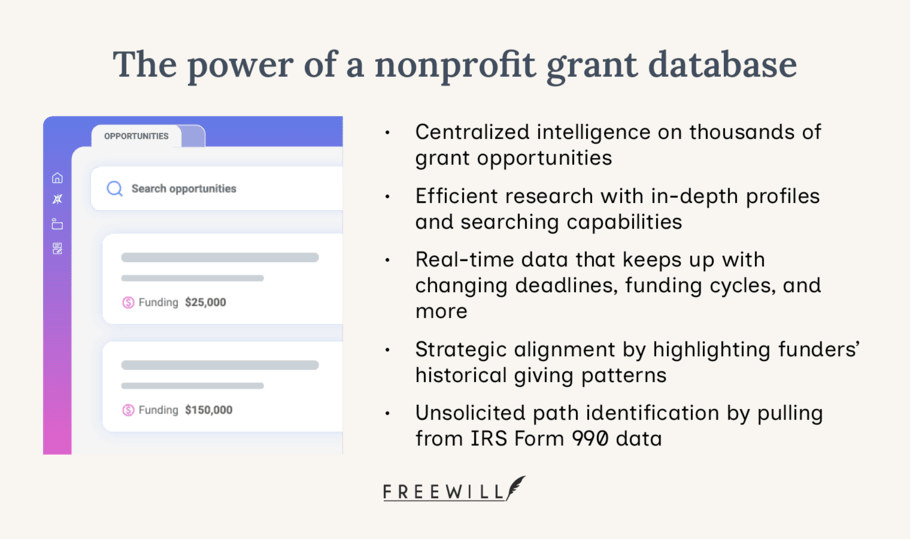
- Consolidate thousands of grant opportunities.
- Enable efficient research through in-depth profiles and intuitive search functionality.
- Provide real-time data for deadlines, funding cycles, and more.
- Highlight funders’ historical giving patterns, including typical grant sizes and the organizations they’ve funded in the past.
- Pull IRS Form 990 data to identify funders that don’t have websites or social media footprints.
Essentially, an effective grant database will help reduce fundraising inefficiencies by finding promising opportunities and ruling out poor-fit ones. Some platforms also allow your team to save opportunities and track deadlines, so you can create your shortlist and not forget about specific grants.
Better Applications: AI-Driven Proposal Writing Tools
The sheer volume of paperwork required for grants can overwhelm even the most experienced development teams. Artificial intelligence (AI) is becoming increasingly common in nonprofit tech stacks, as grantseekers turn to specialized tools that can help draft and refine proposals more efficiently.
Rather than using a general-use platform like ChatGPT, go with purpose-built AI grant writing tools that provide features designed for proposal writing. These platforms often include features tailored to grant workflows, such as storing organizational information, aligning drafts with common proposal formats, and helping ensure narratives address funder requirements.
Using AI in your writing process helps by:
- Creating first drafts of complex proposals based on your previous work.
- Summarizing long RFP documents to highlight key requirements.
- Adjusting the tone of your narrative to align with a specific foundation’s style.
- Freeing up staff time to focus on building relationships with program officers.
Remember, grant proposals often include sensitive organizational information, such as financial details, program strategies, and internal data. Be cautious about where you enter that information. While using free tools can be tempting, public platforms typically store or process prompts in ways that make them unsuitable for confidential proposal content. Meanwhile, purpose-built grant writing platforms with nonprofit-specific privacy protections reduce this risk while still delivering the efficiency of AI.
Efficient Tracking and Stewardship: Grant Management Software
Once you’ve won a grant, you need a way to manage deadlines and keep multiple departments at your organization aligned. A dedicated grant management platform provides a centralized system of record that follows a gift from the initial proposal to the final impact report. This technology offers the oversight needed to maintain compliance while fostering better relationships with grantmakers.
Key benefits of using grant management software include:
- Automated alerts for reporting deadlines and funder check-ins to ensure compliance.
- Centralized storage for all proposal versions, logic models, and award letters.
- Built-in impact tracking that aligns program results with specific grant goals.
- Clear ownership of tasks across different departments to prevent missed requirements.
Many modern grant management systems also integrate with customer relationship management (CRM) systems. Institutional giving is built on relationships, and a CRM helps your organization track grantor relationships. This way, you maintain valuable institutional knowledge about funders even when individual staff members transition out of their roles.
Smart Budgeting: Financial Technology
A grant tech stack is incomplete without robust financial technology capable of handling complex budgeting and compliance requirements. The ability to track restricted funds and provide granular financial reports to funders is essential for winning trust and increasing the chance of future grants.
Modern financial technology moves beyond basic accounting by allowing nonprofits to manage their spending at the source. By using banking platforms built specifically for 501(c) organizations, nonprofits can automate fund accounting and ensure audit-ready transparency.
When banking and spending are unified, you can maintain visibility into how grant money is being used, reducing the risk of misallocation and simplifying complex financial reporting. Here’s how dedicated financial tools can help:
- Dedicated sub-accounts: Create separate digital accounts for specific grants to prevent the commingling of restricted funds with general operating cash.
- Controlled spending with debit cards: Issue digital or physical cards to program staff with pre-set spending limits and merchant restrictions to ensure compliance.
- Automated receipt collection: Allow staff to snap photos of receipts via mobile apps, which are then instantly categorized and attached to the correct grant transaction.
- Financial reporting: Create live dashboards to track spending and generate expenditure reports for funders.
By moving from manual tracking to a unified banking platform, your team can spend less time reconciling receipts and more time sharing the impact of those funds with donors.
Grant Tech FAQ
How do we choose between an all-in-one system and specialized tools?
While all-in-one platforms offer convenience, specialized tools often provide deeper functionality for specific tasks like AI drafting or complex fund accounting. Most large nonprofits find success with a best-of-breed approach, selecting the best tool for each category and using integrations to connect them.
How often should we audit our grant tech stack?
Conduct a comprehensive audit annually. This ensures that your tools continue to meet your organization’s needs, data flows correctly between systems, and you aren’t paying for redundant features across different platforms.
Can AI tools replace the need for a grant writer?
No, AI is not a replacement for human expertise. These tools help with drafting, research, and summarization, but human oversight is still necessary to ensure your narrative is compelling and aligns perfectly with your mission.
As DonorSearch’s guide to AI fundraising explains, “While AI is a powerful tool for efficiency, it cannot replace the fundamental human element that drives philanthropy…Instead, think of fundraising AI as a high-powered assistant rather than a replacement. It can help you automate repetitive tasks and free up your time to focus on what you do best: building authentic connections.”
Wrapping Up
Building a high-performing grant tech stack can substantially increase your organization’s likelihood of winning funding. You can identify promising opportunities, craft stronger proposals, track your grants more effectively, and eliminate manual expense tracking and budgeting.
With this in mind, take a look at your current grant-seeking process. Do you have specialized technology for each stage? If not, it’s worth considering whether a new solution fits in your budget and what features would have the biggest impact on your team.