


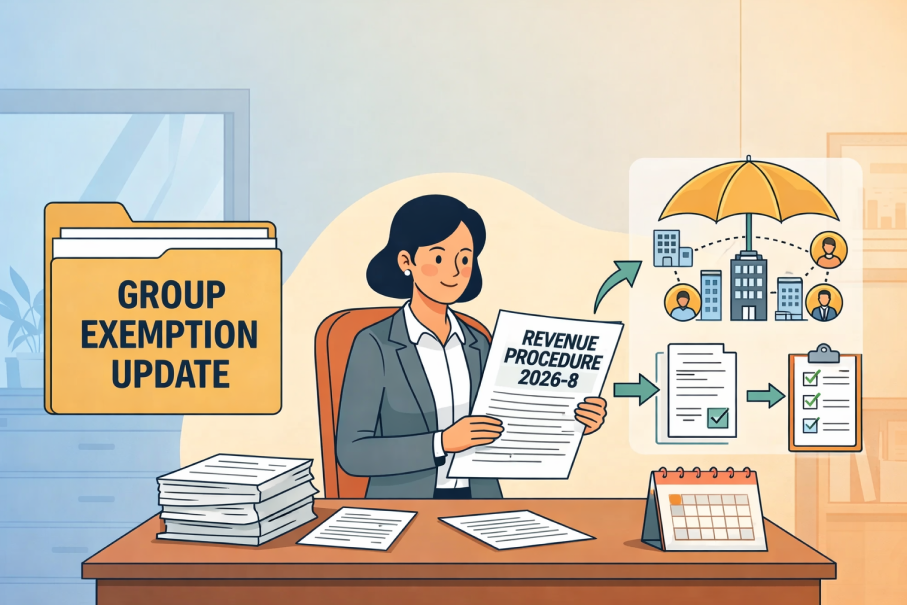
The IRS began accepting new group exemption applications again in January 2026 under Revenue Procedure 2026-8. This major shift, often referred to as the IRS Revenue Procedure 2026-8, updates group exemption rules and procedures, marking the end of a pause that began in mid-2020 and reopened an option used by national nonprofits, associations, and federated organizations with multiple subordinate entities.
TL;DR
- The IRS reopened the group exemption application program in January 2026 under Revenue Procedure 2026-8.
- Applications must now be filed electronically using Form 8940 through Pay.gov.
- The updated rules clarify expectations around documentation, reporting, and the relationship between central organizations and subordinates.
- Ongoing compliance depends on accurate annual reporting, including timely submissions of Supplemental Group Ruling Information (SGRI).
- Organizations considering group exemption should understand how responsibility, reporting, and risk are distributed across their structure.
What Is the IRS Group Exemption Update in 2026?
Revenue Procedure 2026-8 reestablishes the group exemption application process while updating how the IRS evaluates eligibility, structure, and ongoing compliance. The procedure does not introduce a new program, but it clarifies and formalizes requirements that were previously applied inconsistently.
The updated guidance focuses on how central organizations describe their relationship with subordinate entities, how information is documented at the time of application, and how accuracy is maintained over time.
When the Group Exemption Program Was Paused and Reopened
The group exemption program was effectively paused in June 2020, when the IRS stopped accepting new applications. Existing group exemptions remained in place, but organizations could not apply for new group rulings during that period.
As of January 2026, the IRS resumed accepting applications, making group exemption an available option again for eligible organizations.
Is the IRS Accepting New Group Exemption Applications in 2026?
As of January 2026, the IRS is accepting new group exemption applications under Revenue Procedure 2026-8. Applications must be submitted electronically and follow the updated procedural requirements.
What “Reopening” Does and Does Not Mean
Reopening the program means organizations can apply again. It does not mean the process is faster, simpler, or less detailed than before. The IRS continues to closely review applications and expects the submitted information to accurately reflect how the organization operates in practice.
How Does Revenue Procedure 2026-8 Change Group Exemption Requirements?
Filing Format and Electronic Submission Requirements
All group exemption applications must now be filed electronically using Form 8940 through Pay.gov. Paper submissions are no longer accepted.
This change allows the IRS to standardize how applications are reviewed and how information is stored and referenced in future correspondence.
Documentation and Accuracy Expectations
Revenue Procedure 2026-8 places stronger emphasis on clarity and consistency across application materials. Central organizations are expected to provide complete and accurate information about themselves and each subordinate included in the group.
Applications are more likely to be delayed or denied when:
- Required information is missing
- Organizational relationships are unclear
- Application details do not match operational reality
Ongoing Reporting Responsibilities
Group exemption is not a one-time approval. Central organizations are responsible for maintaining accurate information over time, including submitting annual updates through SGRI.
How Do You Apply for a Group Exemption Under Revenue Procedure 2026-8?
To apply for group exemption, organizations must submit Form 8940 electronically via Pay.gov and pay the applicable user fee at the time of filing.
Information Required for Central and Subordinate Organizations
The application requires detailed information, including:
- Identification details for the central organization
- A complete list of subordinate organizations
- Confirmation that each subordinate qualifies for tax-exempt status
- Documentation describing how the organizations are affiliated
Common Causes of Application Delays or Denials
Applications may be delayed or denied when:
- Required information is missing or incomplete
- Descriptions of organizational relationships are unclear
- Submitted details do not align with operational reality
What Does Form 8940 Require Under the New IRS Group Exemption Rules?
Central Organization Disclosures
The central organization must disclose its governing structure, exempt purpose, and role in relation to subordinate entities.
Subordinate Organization Disclosures
Each subordinate must be identified by name, EIN, and address, with confirmation that it operates in alignment with the group’s exempt purpose.
Why Consistency Across Filings Matters
The IRS expects the information provided on Form 8940 to remain accurate beyond the initial filing. Inconsistencies that emerge later may prompt review or correspondence.
What Are the New Affiliation and Control Standards for Central Organizations?
What “General Supervision or Control” Means in Practice
Revenue Procedure 2026-8 reinforces the requirement that central organizations exercise general supervision or control over subordinates. This typically involves having documented authority, defined governance relationships, and access to information needed to confirm compliance.
Areas the IRS now reviews more explicitly
The IRS now reviews:
- Governance relationships
- Documentation of affiliation
- Access to records and reporting
- Alignment of exempt purposes
Which Organizations Qualify as Subordinates Under the Updated Rules?
Shared Exempt Purpose Requirements
Subordinate organizations must share the same exempt purpose as the central organization and operate in a manner consistent with that purpose.
Uniform Purpose Statements for New Subordinates
Organizations added after January 20, 2026, must be accompanied by a Uniform Purpose Statement outlining objectives and operational scope.
What Are the Ongoing Reporting Obligations After Group Exemption Approval?
What SGRI Is and When It Must Be Filed
Supplemental Group Ruling Information (SGRI) must be submitted annually by the central organization to keep group exemption information current.
Information Included in Annual SGRI Submissions
SGRI typically includes:
- Updates to subordinate lists
- Changes to names or addresses
- Confirmation of continued eligibility
How Reporting Issues Typically Surface
Reporting issues often surface during later reviews or unrelated compliance inquiries, rather than immediately after a missed update.
How Do Organizations Maintain Visibility Across Group Structures?
Why Visibility Matters in Multi-Entity Environments
Multi-entity organizations often need clear visibility into financial activity, reporting status, and structural changes to support accurate filings.
How Crowded Supports Group Exemption Oversight
Organizations operating under (or considering) a group exemption need consistent visibility across chapters to meet IRS expectations around oversight and accuracy.
Crowded is built for this structure. The platform helps organizations:
Organize financial and operational data by chapter or entity
Maintain appropriate separation through role-based permissions
Monitor filing status and compliance activity in real time – Learn more
Keep records consistent across entities to support accurate reporting
By structuring visibility at both the entity and permission level, Crowded helps leadership reduce blind spots, support ongoing compliance, and maintain stronger oversight across distributed organizations.
What the IRS Group Exemption Update Means in Practice
The IRS group exemption program is available again under a more clearly defined framework. Revenue Procedure 2026-8 outlines how applications are reviewed, how information must be maintained, and how responsibility flows through group structures.
For organizations with established governance processes and clear visibility across affiliated entities, group exemption remains a viable option. For others, the update highlights the importance of understanding structural tradeoffs before applying.
Rather than changing the purpose of group exemption, the 2026 update makes expectations more explicit, allowing organizations to assess whether the structure aligns with how they already operate.
Secure your group exemption return
with real oversight
Your questions, answered.
Can an organization convert an existing separate 501(C) structure into a group exemption?
Yes. Organizations that previously filed separate exemption applications may apply for a group exemption, but only prospectively. The IRS evaluates the group structure from the application date forward and does not retroactively apply group exemption status to prior filings.
What happens if a subordinate leaves a group exemption voluntarily?
If a subordinate is removed or withdraws from a group exemption, it must obtain its own IRS recognition of exemption or risk losing exempt status. Removal alone does not automatically preserve exemption.
Are international affiliates eligible to be included as subordinates?
Generally, group exemption applies to U.S.-based subordinate organizations. International affiliates may face additional eligibility restrictions and often require separate evaluation or filings.
Does group exemption change how Form 990 is filed for subordinates?
Yes. Subordinates covered by a group exemption still have filing obligations, but the form type and reporting method may differ depending on the group’s structure and the central organization’s reporting practices.
Can a group exemption include entities with different 501(C) classifications?
No. All subordinate organizations must fall under the same 501(c) subsection as the central organization. Mixed classifications require separate exemption filings.
How long does it typically take for the IRS to review a group exemption application?
Processing times vary. Because Form 8940 applications are reviewed for completeness, accuracy, and structural alignment, review periods may extend several months, especially if follow-up questions are required.
Does the IRS charge a user fee for group exemption applications?
Yes. A user fee applies when submitting Form 8940 through Pay.gov. The fee amount is set by the IRS and may change over time.
Can technology replace formal governance documentation for group exemption?
No. Technology can support visibility and recordkeeping, but it does not replace formal governance documents, policies, or legal authority. The IRS evaluates documentation first, supported by operational evidence.
What is the most common mistake organizations make when applying for group exemption?
One of the most common issues is misalignment between how the organization describes its structure on Form 8940 and how it actually operates day to day. Inconsistencies often surface later during reviews.
Is group exemption appropriate for loosely affiliated networks or coalitions?
Group exemption is generally more effective for organizations with defined governance relationships. Informal coalitions or networks without centralized authority may find separate filings more appropriate.
Can a denied group exemption application be resubmitted?
Yes. Organizations may reapply after addressing the issues identified by the IRS, provided they meet eligibility requirements and submit corrected documentation.