


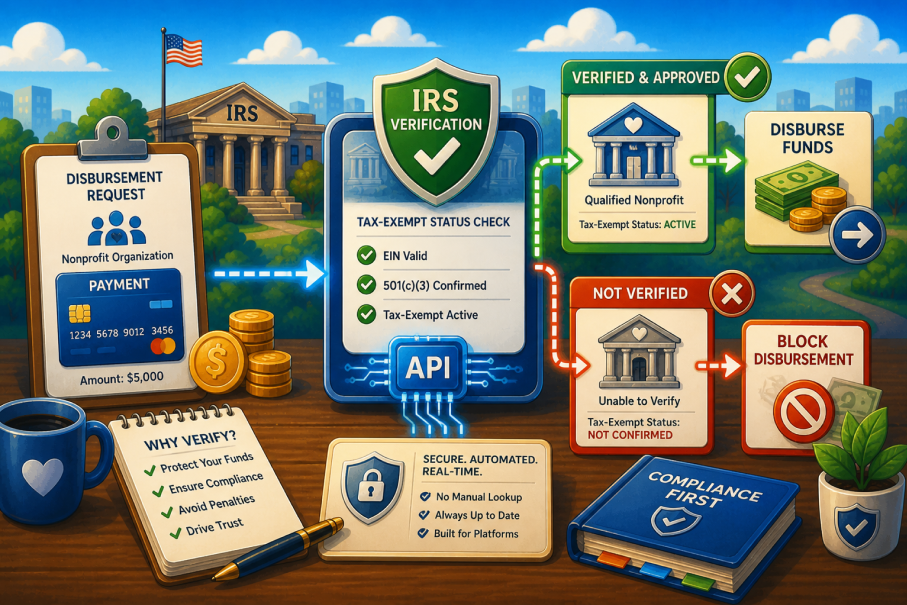
To verify nonprofit tax-exempt status API workflows reliably, you need to check IRS data by EIN before funds are sent. For grantmakers and disbursing platforms, that is a core compliance control.
A nonprofit can lose 501(C)(3) status after three missed Form 990 filings, and the IRS revocation data is updated monthly. That means a payee that passed review before may no longer be eligible today. At scale, manual checks do not work. API-based verification before every disbursement is basic risk management.
TL;DR
- The IRS does not offer a real-time API for verifying nonprofit tax-exempt status. Platforms that skip this check are disbursing blindly.
- 501(C)(3) status can be automatically revoked without warning; the revocation list updates monthly, meaning last quarter’s clean check means nothing today.
- Sending funds to a revoked entity creates direct financial, legal, and audit liability for both the platform and the grantmaker.
- Third-party APIs (CharityAPI, Candid, ProPublica) close the IRS data gap, but only if verification is built into the disbursement workflow.
- Crowded embeds real-time 501(C)(3) verification, continuous status monitoring, and timestamped audit records directly into the payment infrastructure, so compliance is a gate that happens automatically.
Why Tax-Exempt Status Verification Is a Disbursement Prerequisite
Tax-exempt status under 501(C)(3) is not permanent. When an organization is automatically revoked, it is removed from IRS Publication 78 and can no longer receive tax-deductible charitable funds under that status.
For grantmakers and disbursing platforms, the risk is serious. Payments to a revoked nonprofit can expose the organization to legal liability, invalidate tax-deductible contributions, trigger audit findings, and jeopardize compliance with regulated grant programs.
EIN mismatch is a separate but equally serious risk. An organization may operate under a name that differs from its IRS registration, creating room for fraud or misdirected payments. That’s why every verification workflow should rely on EIN.
Manual TEOS checks do not scale. The IRS portal is useful for one-off lookups, but without a real-time API. For teams managing many payees, API-based EIN verification is the only consistent path to compliance.
What the IRS Actually Provides for Nonprofit Tax-Exempt Status Verification and What It Doesn’t
Many teams assume the IRS provides a direct REST API for verifying nonprofit tax-exempt status. It doesn’t.
What the IRS does provide includes:
- Tax Exempt Organization Search (TEOS): A web-based lookup tool covering Publication 78 data, Form 990 filings, automatic revocation records, and determination letters. Useful for manual checks, but not built for programmatic workflows.
- EO BMF (Exempt Organizations Business Master File Extract): Monthly bulk CSV files organized by region. This is the raw dataset that many third-party verification APIs clean, normalize, and serve.
- Automatic Revocation List: A monthly IRS dataset listing revoked organizations, effective revocation dates, and reinstatement dates where applicable.
The gap is clear: none of these resources support real-time EIN verification through a native API. That’s why third-party verification tools exist and why the right one matters for compliance.
Top API Solutions to Verify Nonprofit Tax-Exempt Status
Crowded
Crowded supports nonprofit verification but goes further by connecting that verification to the financial workflows where risk actually happens. Instead of treating exempt-status checks as a separate lookup task, Crowded helps organizations and platforms operationalize verification inside donations, disbursements, AP, and broader nonprofit finance workflows. That makes Crowded a stronger fit for teams that need tighter financial controls, better oversight, and a more complete, compliance-ready infrastructure.
CharityAPI.org
CharityAPI provides a REST API built on IRS data, supporting EIN lookups and returning 28+ fields, including charity classification, deductibility status, and revocation flags. It offers clean JSON responses, a free tier, and paid plans starting at $15/month. Best for developer teams that want a lightweight, standalone API for nonprofit verification.
Candid (GuideStar) Charity Check API
Candid offers one of the deepest datasets in the space, covering 1.8M+ IRS-recognized organizations with daily-validated data. It includes tax-exempt status, public charity classification, financials, Form 990 history, and compliance signals. Best for grantmakers and philanthropy teams that need deeper due diligence.
ProPublica Nonprofit Explorer API
ProPublica’s free API gives access to IRS Form 990 data dating back to 2001 across 1.8M+ nonprofits. You can search by EIN or name and retrieve filing history, financials, and executive compensation. Best for teams that want financial context alongside basic status verification.
CharityVerify
CharityVerify is built for fast business-to-nonprofit verification, returning status, trust grade, category, and flag summaries in lightweight responses. Best for AP and vendor onboarding teams that need quick checks.
The real advantage comes from pairing any of these APIs with an integrated disbursement platform so verification becomes part of the payment workflow.
What Your Nonprofit Tax-Exempt Status API Call Checks and What Can Still Slip Through
When you verify nonprofit tax-exempt status via API, a well-configured call will typically return: current exempt status (active, revoked, or pending reinstatement), the organization’s IRS-registered name for EIN-name mismatch detection, 501(C)(3) subsection classification, deductibility status from Publication 78, revocation date if applicable, and the date of last Form 990 filing.
What can still slip through without layered verification:
- Recently revoked organizations: The IRS revocation list is updated monthly, creating a window during which a newly revoked entity won’t yet appear.
- Name changes not reflected in IRS records: Organizations undergoing rebranding may experience a lag between their operational name and their IRS registration.
- DBA mismatches: Organizations operating under a “doing business as” name that differs from the EIN registration.
- Foreign entities: IRS APIs cover only U.S.-registered nonprofits. UK organizations, for example, fall under the Charity Commission for England and Wales; other regions have equivalent registries.
Best practice: verify with the sub-grantee during onboarding and again immediately before each disbursement. A one-time check at intake does not satisfy compliance requirements for ongoing grant programs.
How to Verify Nonprofit Tax-Exempt Status via API Step by Step
The following process applies whether you’re integrating a third-party nonprofit tax-exempt status API into a disbursement platform or running manual EIN lookups before each payment cycle.
- Collect the EIN. Obtain the organization’s Employer Identification Number (formatted as XX-XXXXXXX). Never rely on the name alone. EINs are the authoritative IRS identifier.
- Choose your verification API. Select based on use case: CharityAPI for lightweight developer integration, Candid for deep compliance workflows, ProPublica for filing history and financials.
- Submit an EIN lookup request. Pass the EIN as a query parameter to your chosen API endpoint. Most REST APIs return a JSON response.
- Parse the response. Check for exempt_status, pub78_verified, revocation_date, and deductibility. Flag any result where the status is not active, or where the registered name doesn’t match your records.
- Cross-reference the Automatic Revocation List. For high-stakes disbursements, cross-check the IRS auto-revocation list, updated monthly and available for bulk download.
- Log and timestamp the verification. Store the API response and a timestamp in your audit trail. This is your compliance documentation if a payment is ever questioned.
- Re-verify before every disbursement. Onboarding verification is not permanent. Re-run the check immediately before each payment cycle.
For teams building in Python, the requests library makes it straightforward to hit CharityAPI or ProPublica endpoints. A basic GET request to the CharityAPI EIN endpoint returns JSON-formatted IRS record data in milliseconds.
How Crowded Automates This as Part of Compliance-First Disbursement
Most platforms treat nonprofit tax-exempt verification as a manual pre-payment step. That creates two risks: someone forgets to check, and there’s no automatic audit trail if they do. Crowded builds verification into the workflow. Its API checks IRS data in real time, returning current 501(C)(3) status, organization details, and a verification timestamp, all logged automatically.
For platform partners, this means tax-exempt status verification is a built-in compliance gate within grant and disbursement flows. For finance teams, the benefit is a single audit-ready system for verification, Form 990 filing, EIN management, and fund disbursement, without fragmented tools or manual cross-checking.
Crowded’s AI-powered compliance layer also monitors for status changes, flags risks, and preserves the timestamped records needed for audit readiness.
The Bottom Line
Verifying nonprofit tax-exempt status before every disbursement is a basic risk management practice. The IRS’s third-party tools built on IRS data enable scalable verification.
The real question is whether verification is a manual task or a built-in compliance gate in your payment infrastructure. For high-volume disbursement workflows, only the second option scales.
Ready to see compliance-first disbursement in action? Book a demo with Crowded or explore Crowded’s API for platform partners.
Frequently Asked Questions
Tax-exempt status vs. good standing: what's the difference?
Tax-exempt status confirms IRS 501(C)(3) recognition. Good standing goes further, covering state compliance and operational status. You need both for clean disbursement compliance.
Is one-time verification enough?
No. Status can change anytime. Continuous monitoring is essential to avoid disbursing to revoked nonprofits.
Can a revoked nonprofit be reinstated?
Yes. Once reinstated, it reappears in IRS records, but your system must reflect real-time status.
What’s the risk of paying a revoked nonprofit?
It can invalidate tax deductions, trigger audit findings, and expose the organization to compliance risks. Timestamped verification records are your baseline protection.
Why not just use a verification API like CharityAPI or Candid?
They provide data, but you still manage queries, storage, and workflows. Platforms like Crowded embed verification directly into disbursement, automatically logging results.
Does this apply to fiscal sponsorships?
Yes, especially. Sponsors are responsible for compliance, making real-time verification critical before releasing funds.
What if an EIN doesn’t verify?
Don’t disburse. Confirm formatting, request documentation, and re-check. Automated systems can flag these issues before payments are triggered.