


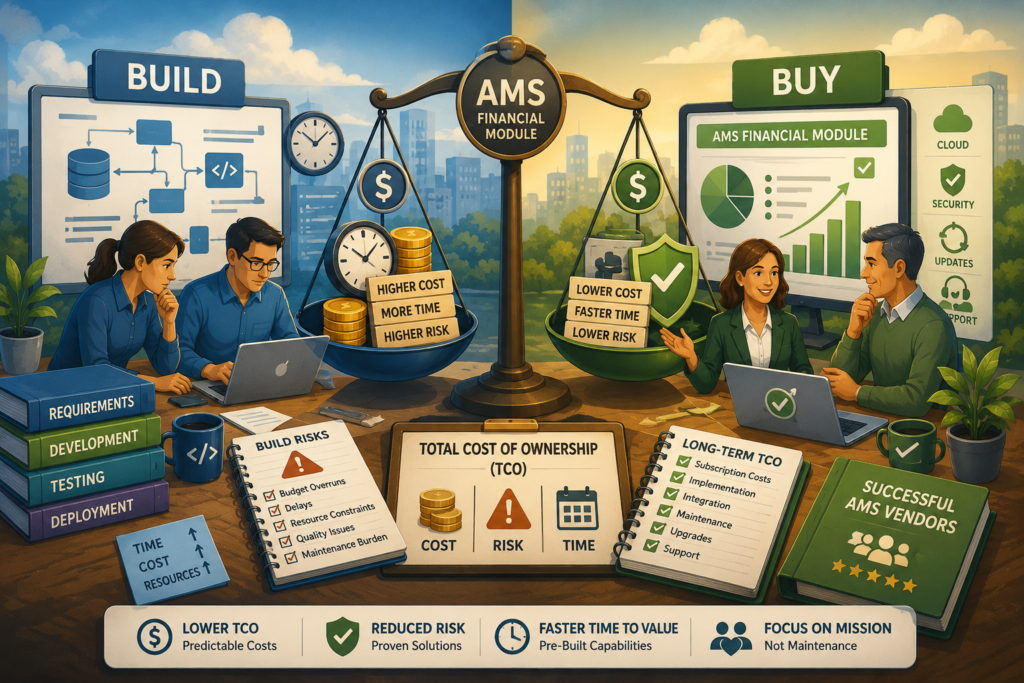
An AMS financial module build vs buy decision rarely starts as a finance infrastructure decision. It starts with smaller, cleaner dues collection, chapter-level reporting, and a payment integration.
Then the module grows. Payments become reconciled. Reconciliation becomes ledger logic. Ledger logic becomes permissions, disbursements, audit trails, KYC/KYB, chargebacks, compliance, and more.
The question changes fast. You are no longer asking, “Can we build a financial module?” You are asking, “Do we want to operate financial infrastructure?”
That is the decision. A long-term operating commitment tied to compliance, reconciliation, support burden, and multi-entity visibility. The challenge was never whether an AMS can build financial workflows. It is whether the vendor wants to absorb the full lifecycle cost of maintaining them.
TL;DR
- Building an AMS financial module looks cheaper at first, but the cost shows up after launch through reconciliation, refunds, permissions, compliance support, and customer exceptions.
- Most AMS vendors should build the customer-facing workflow, not the full financial infrastructure layer behind payments, disbursements, audit trails, and multi-entity controls.
- The build vs buy decision becomes riskier when associations need chapter-level visibility, controlled spending, restricted fund tracking, or IRS-aligned reporting.
- Embedded finance enables AMS platforms to achieve financial functionality faster without diverting engineering teams from core product priorities.
- Crowded helps AMS vendors support nonprofit and association finance workflows with multi-entity visibility, controlled disbursements, automated categorization, and reduced compliance burden.
Why AMS Vendors Consider Building Financial Modules
Payments are sticky. Financial data is strategic. Customers dislike reconciling spreadsheets and toggling between processors, banks, accounting software, and chapter tools. A custom module offers more control, new revenue streams, better retention, and deeper reporting.
The logic is understandable; the AMS already holds member records, chapter structures, and dues schedules. Adding financial workflows feels like the next natural expansion. But the danger is scope creep.
Should AMS Vendors Build or Buy?
Most AMS vendors should buy or embed financial infrastructure rather than build it. A build path works for limited goals:
- Basic payment acceptance
- Simple invoice tracking
- Lightweight accounting exports
A buy path becomes stronger when the module touches:
- Multi-entity financials or chapter sub-accounts
- Restricted funds or disbursements
- KYC/KYB, audit trails, or compliance monitoring
- IRS-aligned categorization
- Embedded banking* or card programs
Build the experience layer. Buy the regulated, operationally heavy financial infrastructure layer.
AMS Financial Module Build vs Buy Comparison
For most vendors, the AMS financial module build vs buy decision comes down to one question: should the platform own its financial infrastructure internally, or embed a specialized finance layer designed for association complexity? The answer usually depends on operational scope, compliance exposure, and long-term maintenance tolerance.
Factor | Build Internally | Buy or Embed |
Time to market | Often 12–24+ months | Faster deployment |
Compliance ownership | Mostly internal | Shared with the provider |
Financial module TCO | Grows over time | More predictable |
Engineering maintenance | Continuous | Reduced |
Multi-entity support | Difficult to scale | Already structured |
Reconciliation complexity | Internal burden | Embedded workflows |
Fraud and risk monitoring | Requires dedicated operations | Usually provider-supported |
Payment infrastructure expertise | Must build internally | Already operational |
Customer support burden | High | Lower operational strain |
Scalability across chapters | Custom logic required | Native architecture support |
Most AMS vendors underestimate the operational cost of maintaining financial infrastructure long after launch.
The Hidden Cost Curve of Building
Financial infrastructure costs accumulate across engineering, compliance, support, fraud management, and reconciliation, and grow as customers request exceptions.
Engineering and Product Cost
The first version looks manageable. The second and third become harder as customers request chapter-specific permissions, multiple payment methods, refund and partial payment logic, accounting sync rules, batch reconciliation, and role-based approvals.
Compliance and Risk Cost
Financial workflows create obligations around onboarding, identity verification, transaction monitoring, and recordkeeping. For associations, complexity is sharper, leadership changes, chapter structures vary, IRS status matters, and funds may span multiple entities.
Support Cost
Finance tickets are different. A broken button is annoying. A missing payment is urgent. A reconciliation mismatch can affect board reporting. A delayed disbursement can damage chapter trust. Support teams need scripts, escalation paths, and deep product knowledge.
Partnership and Vendor Management Cost
Even a “built” module depends on processors, banking partners, fraud vendors, and accounting platforms, meaning contracts, changing APIs, fee structures, and customer-facing explanations when something outside your system breaks.
Opportunity Cost
Every sprint spent on financial infrastructure is a sprint not spent on the AMS core. Your competitive advantage may be member experience, event management, or chapter administration. Building the full financial stack can pull focus from what actually differentiates you.
The build cost is front-loaded. The regret cost is cumulative.
The Financial Infrastructure Layer AMS Vendors Don’t Have to Build
Crowded gives AMS vendors a way to add financial infrastructure without building the full stack. For associations and multi-chapter organizations, the value goes beyond payment acceptance; it is about visibility, control, and alignment of compliance across entities.
Crowded supports the parts hardest for AMS vendors to maintain alone: multi-entity visibility across chapters and programs, controlled disbursements tied to approvals and budgets, automated IRS-aligned categorization, and reduced compliance burden across nonprofit reporting requirements.
AMS vendors can embed a financial layer designed for how associations actually operate, where chapters need autonomy, headquarters need oversight, finance teams need clean records, and members expect simple payment experiences.
Final Takeaway: The Best AMS Financial Module Strategy Is Layered
The AMS build vs. buy decision comes down to operational ownership. Most vendors can build payment features. Far fewer are prepared to own the long-term TCO, compliance, reconciliation complexity, and support burden of running financial infrastructure at scale.
The right strategy is layered: build what strengthens your core AMS, member flows, admin UX, reporting, and configuration. Buy or embed what creates operational drag, payments infrastructure, disbursement controls, compliance workflows, and audit-ready financials.
That’s how AMS vendors protect roadmap focus while meeting associations’ rising financial expectations. The winners will treat financial infrastructure as its own layer, and choose the fastest, safest, most scalable way to bring it in.
* Crowded Technologies Inc is a financial technology company and is not a bank. Banking services provided by i3 Bank; Members FDIC. The Crowded Technologies Inc. Visa® Debit Card is issued by i3 Bank pursuant to a license from Visa U.S.A. Inc. and may be used everywhere Visa debit cards are accepted.
Frequently Asked Questions
What is the biggest mistake AMS vendors make when building financial modules?
They mistake payment acceptance for financial infrastructure. The complexity comes later through reconciliation, disbursements, compliance, support, and audit-ready reporting.
Why is building an AMS financial module expensive over time?
The cost grows after launch because customers start needing refunds, permissions, reporting exceptions, approval flows, reconciliation logic, and compliance support.
When should an AMS vendor buy instead of build?
An AMS vendor should buy or embed when customers need multi-entity visibility, controlled disbursements, compliance-ready records, or chapter-level financial oversight.
Can an AMS vendor add financial tools without becoming a fintech company?
Yes. Embedded finance enables AMS vendors to offer financial workflows within their platforms while relying on specialized infrastructure providers for the heavier operational layer.
How does Crowded help AMS vendors?
Crowded helps AMS vendors add financial infrastructure for associations and nonprofits, including multi-entity visibility, controlled disbursements, IRS-aligned categorization, and reduced compliance burden.