


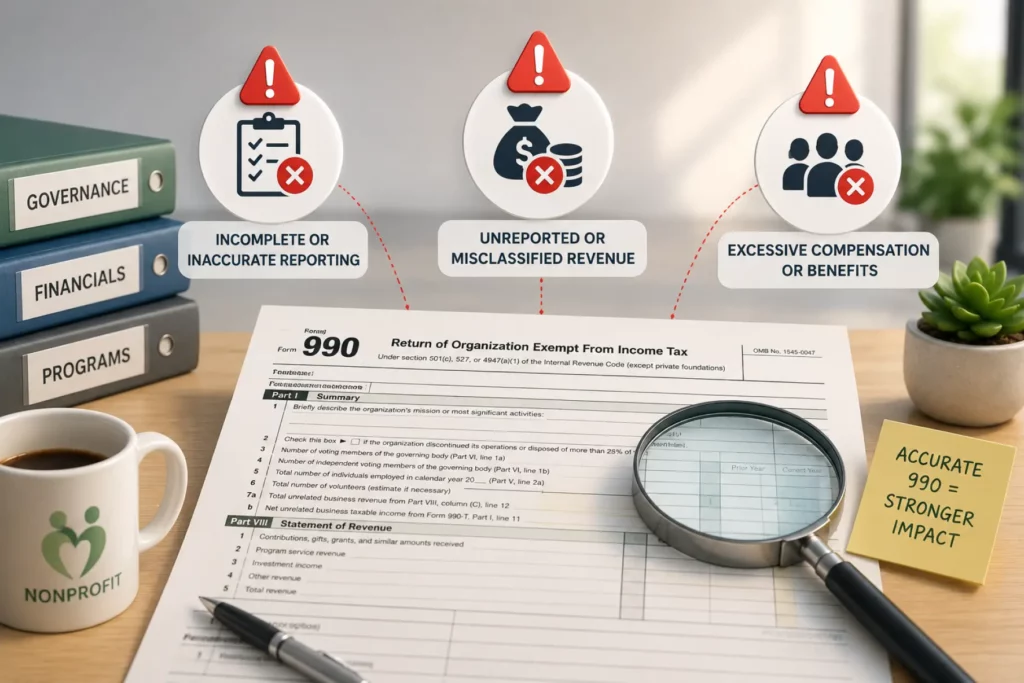
IRS 990 risk rarely starts with one bad line item. For complex nonprofits, the danger is inconsistency: numbers that don’t reconcile, governance responses that don’t reflect reality, and related-entity activity outside finance’s view.
For CFOs and Controllers, Form 990 is a public risk document, scrutinized by the IRS, funders, watchdogs, and regulators. The most dangerous red flags come from infrastructure gaps.
TL;DR
- The biggest IRS 990 mistakes are usually infrastructure failures. For complex nonprofits, scrutiny often starts with inconsistent data across chapters, affiliates, funds, and related entities.
- Functional expense allocation, governance disclosures, and Schedule R reporting are three major red-flag areas on Form 990. Each one requires documentation.
- Form 990-T exposure can be easy to miss when revenue is generated across events, sponsorships, partnerships, or chapter accounts. CFOs need visibility before filing season.
- A clean Form 990 depends on year-round financial controls. Crowded* helps nonprofits strengthen account visibility, approval workflows, role-based controls, and audit trails across distributed teams.
- The real risk is inconsistency. If the filing, board records, compensation data, and financial activity tell different stories, the organization becomes easier to question.
Mistake #1: Treating Functional Expenses as an Accounting Afterthought
Functional expense reporting is one of the clearest IRS scrutiny triggers. Form 990 Part IX requires expenses allocated across program service, management, and fundraising. The issue is whether the allocation method is reasonable, documented, and consistent.
What raises red flags in nonprofit functional expense allocation?
Functional expense allocation becomes a Form 990 red flag when the organization reports clean ratios without clear support, changes allocation methods without explanation, or applies different expense logic across departments, chapters, grants, and related entities.
Common risk patterns include:
- Program expenses that look unusually high compared with actual operating activity
- Fundraising costs are buried inside program or management categories
- Shared payroll allocated without time studies or documented methodology
- Chapter or affiliate expenses are classified differently from the parent entity
- Grant-restricted expenses tracked separately in spreadsheets, then manually reclassified at year-end
- Sudden year-over-year allocation changes with no Schedule O explanation
For multi-entity nonprofits, this gets harder fast. Chapters may use different bookkeeping habits. Affiliates may code the same expense three different ways. Staff and contractors may tag expenses without a shared chart of accounts or a review layer. That’s when functional expense allocation stops being a tax-prep issue and becomes an operating-system issue.
Visibility Before Year-End Cleanup
Crowded helps nonprofit finance teams build visibility around spending, approvals, and audit trails, before 990 prep begins. For chapter-based organizations, the problem usually isn’t knowing the rules. It’s not seeing enough transaction activity early enough to correct it. With clearer controls and entity-level visibility, CFOs spend less time on year-end reconstruction.
Mistake #2: Reporting Governance Policies That Do Not Match Reality
Many nonprofits answer governance questions as if Form 990 were asking, “Do we have a policy?” That is only part of the risk. The deeper question is whether the organization can demonstrate that its nonprofit governance policies are active, up to date, and consistently followed.
Do governance answers on Form 990 trigger IRS scrutiny?
Governance answers draw scrutiny when an organization reports strong policies but lacks the board minutes, conflict disclosures, or approval records to back them up. Form 990 asks about governance because it directly affects tax compliance, private benefit risk, and compensation oversight.
What governance policies should finance leaders review before filing?
At a minimum, CFOs and Controllers should review whether the organization has current, board-approved versions of:
- Conflict of interest policy
- Whistleblower policy
- Document retention and destruction policy
- Executive compensation review process
- Gift acceptance policy
- Related-party transaction review policy
- Investment or reserve policy
- Chapter financial control policy
- Expense reimbursement policy
- Grant and restricted fund policy
The issue is a mismatch. If Form 990 says the board reviewed the return, there should be evidence of how it did so. If a conflict of interest policy is reported, there should be annual disclosures. If compensation was reviewed using comparability data, the minutes should show it.
Where Form 990 Compensation Reporting Becomes Risky
Form 990 compensation reporting can trigger an IRS audit when executive pay, officer compensation, related-party arrangements, or contractor payments appear unsupported or inconsistent.
Red flags include:
- Compensation that increased sharply without documented approval
- Officers are paid through related entities, but this is not clearly disclosed
- Former officers or key employees omitted
- Independent contractor payments that should have been reviewed more closely
- Benefits, bonuses, housing, travel, or deferred compensation are reported inconsistently
- Compensation narratives that do not match payroll records or board minutes
For federations and associations, compensation risk can spread across the structure. A related foundation, management company, chapter, or supporting organization may pay part of an executive’s compensation. If the parent organization does not have a full view of those arrangements, the Form 990 can tell an incomplete story.
Mistake #3: Underreporting Related Organizations, UBI, and Cross-Entity Activity
The third major category of IRS 990 mistakes involves activities that sit outside the main entity’s clean financial statements. This includes related organizations, disregarded entities, supporting organizations, partnerships, chapters, affiliates, taxable subsidiaries, and revenue streams that may trigger unrelated business income reporting.
Why Schedule R reporting matters for complex nonprofits
Schedule R reporting is required when a Form 990 filer has certain related organizations or conducts certain transactions with them or with unrelated partnerships. For complex nonprofit structures, Schedule R can become a map of the organization’s legal and financial relationships.
What raises red flags in Schedule R reporting?
Schedule R raises red flags when related entities, intercompany transactions, shared employees, grants, loans, rent, royalties, management fees, or partnership interests appear in financial records but are missing, incomplete, or inconsistently described on Form 990.
Common mistakes include:
- Missing related organizations because finance only reviewed the main EIN
- Failing to report transactions between the parent and affiliates
- Treating chapters as operational units without confirming legal status
- Omitting taxable subsidiaries or supporting organizations
- Inconsistent descriptions of control, ownership, or relationship type
- Forgetting unrelated partnerships where the nonprofit conducts significant activity
For associations and federated nonprofits, this can be a real exposure point. The IRS and public reviewers are looking at the broader structure.
Where Form 990-T mistakes enter the picture
Form 990-T mistakes often occur when revenue is treated as mission-related solely because the organization is exempt. That is not enough.
Unrelated business income risk can appear in:
- Advertising income
- Sponsorship arrangements with substantial return benefits
- Rental income with debt-financed property issues
- Merchandise sales
- Event revenue with commercial characteristics
- Licensing, royalties, or affinity arrangements
- Partnership income
- Services provided to nonmembers or external parties
When does a nonprofit need to review Form 990-T exposure?
Nonprofits should review 990-T exposure whenever revenue comes from activities not substantially related to their exempt purpose. The bigger CFO-level issue is classification. Revenue may sit inside a CRM, AMS, event system, or affiliate account before finance ever sees it. By the time 990 prep begins, the organization is classifying revenue after the evidence is scattered.
The IRS Scrutinizes Errors and Inconsistency.
The most dangerous IRS 990 mistakes are not always the most obvious. A typo can be corrected. A late supporting document can be added. A missing attachment can be explained. But cross-entity inconsistency is harder to defend. For complex nonprofits, IRS scrutiny often begins when the filing suggests the organization lacks a reliable internal view of itself.
That can show up as:
- Financial statements that do not align with Form 990 categories
- Governance answers are unsupported by board records
- Compensation reporting that misses related-entity payments
- Functional expenses that change without documentation
- Schedule R disclosures that omit known relationships
- Form 990-T exposure is ignored until after filing
- Chapter-level activity is invisible to the parent organization
The underlying issue is operational control. A strong Form 990 process starts long before tax season. It depends on entity visibility, role-based controls, consistent categorization, documented approvals, and accessible audit trails.
How Crowded Helps Nonprofits Reduce 990 Risk Before Filing Season
Crowded doesn’t just help organizations prepare for 990 season — it handles 990 filings directly. For organizations on a group exemption, Crowded files the 990-N, 990-EZ, and full Form 990 on behalf of chapters, eliminating the compliance gap that causes auto-revocation under IRC §6033(j).
Beyond filing, Crowded provides the financial infrastructure that makes accurate 990 preparation possible in the first place: sub-account architecture that maps activity to the right chapter or entity, role-based spend controls, transaction categorization, and audit trails that reflect how approvals happened — not how they were reconstructed later.
Most 990 red flags are downstream symptoms of upstream fragmentation. Crowded addresses both ends — the filing itself and the infrastructure behind it.
CFO Checklist: How to Catch IRS 990 Mistakes Before They Become Red Flags
Before filing, finance leaders should ask:
- Do functional expense allocations follow a documented, board-approved methodology?
- Are expense categories applied consistently across departments, chapters, and affiliates?
- Do governance answers match actual board minutes, approvals, and policy records?
- Do independent review and comparability data support executive compensation?
- Have related organizations and transactions been reviewed beyond the main EIN?
- Does Schedule R reflect the organization’s full legal and operational structure?
- Have all revenue streams been reviewed for Form 990-T exposure?
- Are restricted funds, grants, and chapter accounts supported by clean transaction records?
- Can finance explain major year-over-year changes before an external reviewer asks?
- Is the Form 990 reviewed as a governance document?
The Best 990 Defense Is Operational Clarity
Form 990 is where operational habits become public record. For complex nonprofits, the highest-risk mistakes come from fragmented systems, inconsistent chapter practices, and weak documentation.
CFOs need a financial infrastructure that makes accurate reporting easier all year. When an organization can see its money, prove its controls, and document its decisions, Form 990 stops being a risk event and becomes a credible governance signal.
* Crowded Technologies Inc is a financial technology company and is not a bank. Banking services provided by i3 Bank; Member FDIC. The Crowded Technologies Inc. Visa® Debit Card is issued by i3 Bank pursuant to a license from Visa U.S.A. Inc. and may be used everywhere Visa debit cards are accepted.
There are no fees associated with account opening, but transaction fees may apply; please refer to the Crowded Business Deposit Account Agreement for more details on account transaction fees.
Frequently Asked Questions
Can a nonprofit amend Form 990 after filing?
Yes. Nonprofits can file an amended Form 990 to correct material errors. Keep documentation showing what changed and why.
Should the board review Form 990 before filing?
Yes. Board review supports stronger governance and helps leaders catch compensation, related-party, and disclosure issues before the return becomes public.
Do clean audits mean Form 990 is low-risk?
Not always. A clean audit may still miss Form 990 red flags around governance, compensation, Schedule R, or public disclosure consistency.
How do bank records affect Form 990 accuracy?
Bank records support revenue, expenses, restricted funds, and inter-entity activity. Crowded helps nonprofits centralize account visibility, controls, and audit trails before filing season.
How can chapter-based nonprofits reduce 990 inconsistencies?
Use standardized account structures, approval workflows, and reporting rules across chapters. Crowded supports centralized oversight while letting local units operate within defined controls.
Why is Form 990 harder than regular bookkeeping?
Form 990 connects numbers to governance, compensation, related entities, and compliance narratives. Accurate books help, but consistent documentation completes the story.